
The PMO Mastery Guild


OVERVIEW
What the Guild is
THE REASON BEHIND IT
Why a guild, and why now
PMO Mastery has never sold knowledge. It has always made the harder claim: that knowledge becomes understanding. A knowledge test would contradict everything the brand stands for. An assessment of real work does not. A paper followed by a deep interview is the only instrument that can test understanding rather than recall.
The philosophical anchor is a single line from Goethe’s 1800 sonnet Natur und Kunst: “In der Beschränkung zeigt sich erst der Meister”: it is in working within limits that the master first shows themselves. The line carries three meanings at once, and a true master scores on all three: command the rules of the craft before departing from them; deliver value within the real constraints of your context, the budget, the resistance, the half-staffed team; and know your own limits and show it when it matters. The second line completes the thought: “Und das Gesetz nur kann uns Freiheit geben” — only the law can give us freedom. Structure is what makes mastery free.
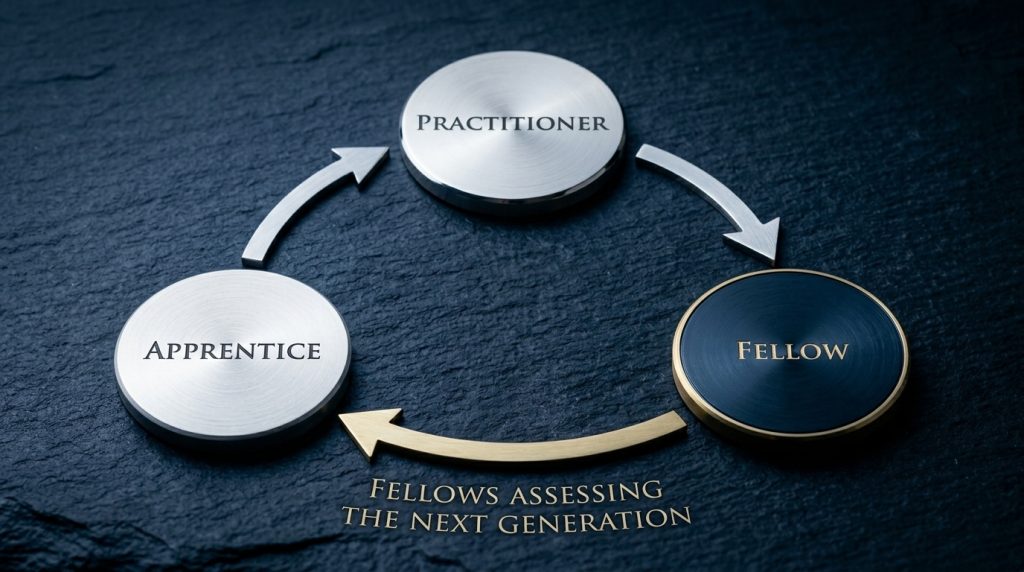
One road, three grades
The guild begins with the apprentice, not the master. The lowest grade is a real first step on a recognized road, not a softened standard. The shield grows with the member: it is earned, never handed out.
GRADE 1

PMO Mastery Apprentice
“I stand at the beginning of a recognized road.” One real case from your own practice and the deliberate use of a PMO instrument. You knew that it would work and when it fit.
- Short, focused assessment
- No shield yet but only the flame. The apprentice has not yet proven they can carry the standard
- An honest picture of where you stand
GRADE 2

PMO Mastery Practitioner
The real threshold, where the filter sits. A substantial case with genuine tension: a choice under pressure, a setback, a non-obvious trade-off. Not a report but a defense. You prove you can recognize a framework’s shortcomings and resolve them through real adaptation.
- Deep, probing interview which is the heart of the system
- The shield is earned here
- The grade that carries meaning for an employer
GRADE 3

PMO Mastery Fellow
Deliberately rare. Proven mastery plus the ability to pass it on: to guide others, to judge another’s work against the standard and defend that judgment before fellow masters.
- Earns the right to assess Apprentices and Practitioners
- Completes the shield, with Goethe’s line as its inner layer
- Lifelong, with the possibility of withdrawal to protect the standard

The interview assessment
The paper is the occasion; the interview decides. A brilliant paper with a shaky conversation does not pass. A modest paper whose interview brings the depth to the surface can. This is exactly where AI-generated papers fail: a generated paper carries no lived interview behind it.
Every grade is judged across three constant dimensions, the three facets of mastery: commanding the rules of the craft, delivering value within real constraints, and knowing your own limits. Passing is not “no mistakes” but “holds up under questioning.”
The guild that renews itself
A recognition system anchored in one person’s judgment cannot scale, and a system that scales by lowering its bar is worthless. The guild resolves this the way guilds always have: the journeyman who becomes a master may then train and judge journeymen of their own. The highest grade produces the future assessors. The community reproduces itself.
This is done in a deliberate order to protect quality. The standard is first made explicit in an assessment rubric. New assessors then judge alongside an existing master until their judgments align, calibrated case by case. Only then do they work independently, with periodic sampling to guard against drift. It costs more time up front, not less. The PMO Mastery Guild Register holds the names of all guild members.
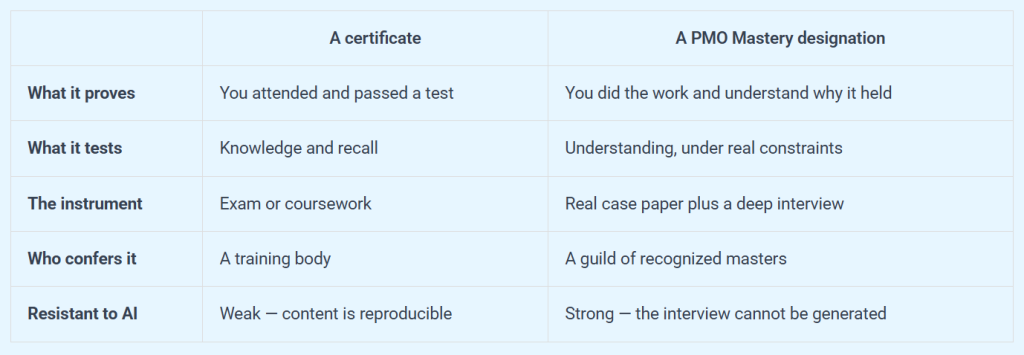
Designation versus certificate
QUESTIONS & ANSWERS
Q&A
Is this a title I can put after my name?
Why only three grades?
What if I work inside a framework someone else chose, like SAFe or Agile?
Can a paper be written by AI?
Does the designation expire?
Why “Fellow” and not “Master”?
Begin the road
The guild begins with the apprentice. If you want recognition that reflects what you can actually do, this is the first step.